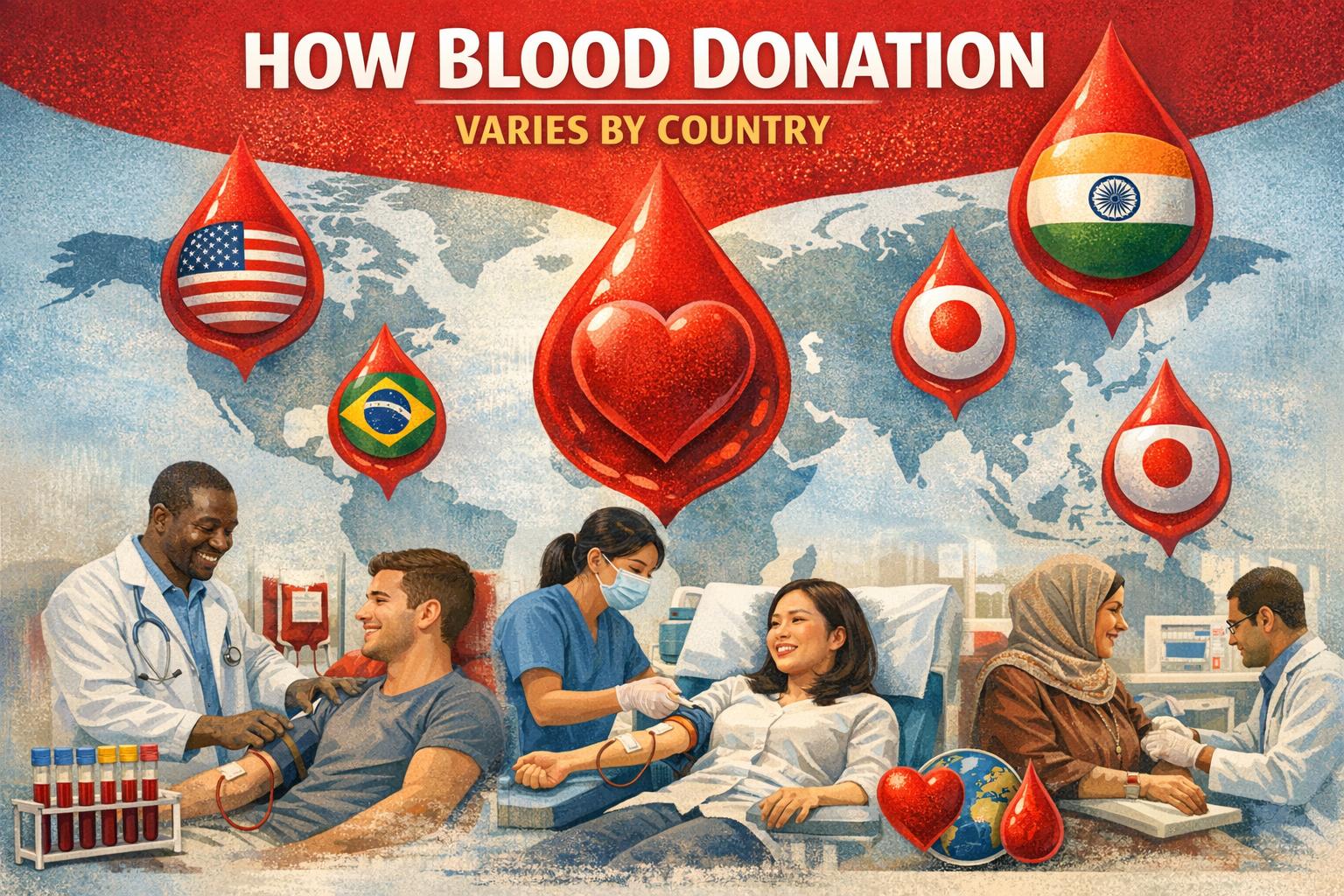
Introduction to Blood Donation Practices
Blood donation is a foundational element of modern healthcare systems. Hospitals rely on a stable and safe blood supply to perform surgeries, respond to traumatic injuries, manage childbirth complications, and treat chronic conditions such as anemia, cancer, and genetic blood disorders. Although the biological process of blood donation is broadly similar across the world, the systems that support it differ considerably. These differences arise from variations in economic development, regulatory frameworks, public health priorities, cultural norms, and technological capacity. As a result, the availability, safety, and distribution of blood products show significant variation between countries and regions.
Blood cannot be manufactured synthetically in quantities sufficient to replace donated blood. While research into artificial blood substitutes continues, donated human blood remains the primary source for transfusion therapy. Whole blood is typically separated into components such as red blood cells, plasma, and platelets, allowing a single donation to benefit multiple patients. The efficiency and sustainability of these systems depend on ongoing participation by donors and effective management by national health authorities.
Historical Development of Modern Blood Donation Systems
The organization of blood donation systems developed gradually during the twentieth century. Early transfusions were often direct person-to-person procedures, carrying high risk due to limited knowledge of blood groups and compatibility. The identification of ABO and Rh blood group systems significantly improved safety. During the world wars, structured blood banking systems emerged to meet the needs of injured soldiers. After these conflicts, civilian blood services expanded, leading to the establishment of centralized blood banks in many countries.
In high-income nations, national or regional blood services became institutionalized, supported by regulatory agencies and standardized protocols. International organizations, including the World Health Organization, contributed to guidelines promoting voluntary non-remunerated blood donation as a preferred model. Over time, advances in screening for infectious diseases such as HIV, hepatitis B, and hepatitis C further enhanced transfusion safety. Nevertheless, the degree to which these developments have been implemented varies widely across countries.
Factors Influencing Blood Donation
Blood donation rates and practices are shaped by interconnected factors. Government policies determine eligibility criteria, testing requirements, and organizational structure. Cultural attitudes influence whether individuals view donation as a civic responsibility. Economic conditions shape the feasibility of operating collection centers and maintaining cold chain logistics. Education and public awareness campaigns affect understanding of the need for regular donation. Together, these elements produce distinct national profiles in blood donation systems.
Government Policies and Regulations
In many countries, blood donation services operate under direct government supervision or through nationally mandated agencies. Regulatory authorities establish donor eligibility standards, including age limits, health requirements, and deferral periods for certain medical conditions or travel histories. Screening procedures for infectious diseases are also strictly defined. In the United States, for example, blood establishments follow guidelines issued by the Food and Drug Administration, which set standards for donor screening, blood testing, labeling, and storage. European Union member states follow common directives that harmonize safety and quality requirements across borders.
In contrast, some low- and middle-income countries may have fragmented oversight systems. Blood banks might operate at local or regional levels with varying standards. Limited financial resources can restrict comprehensive screening for transfusion-transmissible infections. While many of these countries strive to align with international standards, challenges such as insufficient laboratory capacity, unreliable electricity supply, and shortages of trained personnel can impede implementation.
Policy decisions also influence donor recruitment strategies. Some governments invest heavily in national awareness campaigns and centralized call systems, while others rely more on hospital-based recruitment. Legal frameworks may prohibit paid donation to reduce the risk of donors concealing medical history. Countries that have adopted strict voluntary donation policies often report higher safety outcomes, though maintaining sufficient supply requires sustained public engagement.
Cultural Attitudes and Public Awareness
Cultural perceptions of blood and medical procedures strongly influence donation rates. In some societies, blood is associated with strength or vitality, and individuals may believe that donating weakens the body. Misconceptions regarding health risks, sterility of equipment, or religious permissibility can discourage participation. In other contexts, blood donation is widely regarded as a civic contribution, integrated into community events or workplace initiatives.
Public awareness campaigns can shift perceptions gradually. Information about the safety of the process, the body’s ability to regenerate donated blood components, and the medical need for regular donations contributes to informed decision-making. Education systems that introduce topics related to blood and health science at an early age often see improved donor participation among younger adults. Media coverage of emergencies that require large volumes of blood can temporarily increase donations, though sustaining long-term commitment typically requires structured outreach strategies.
Religious and ethical guidance also plays a role. Many religious authorities explicitly support blood donation as compatible with faith-based obligations to protect life. Where uncertainty exists, collaboration with community leaders can clarify positions and address concerns. Effective communication strategies usually adapt messages to local languages and cultural contexts rather than relying on standardized campaigns.
Voluntary vs. Paid Donation Systems
One of the most significant distinctions in global blood donation practices is the reliance on voluntary non-remunerated donation versus paid or compensated donation. International health authorities generally endorse voluntary systems on the grounds that donors who give blood without financial incentive are more likely to provide accurate medical histories, thereby reducing infection risk. Many high-income countries have achieved nearly 100 percent voluntary donation rates through sustained public engagement and institutional trust.
In contrast, some countries continue to rely partially on paid donors to meet demand. Compensation may take the form of direct payment or indirect benefits such as vouchers. While this approach can temporarily increase supply, it raises concerns about donor honesty and equity. Individuals in financial hardship might feel pressured to donate, potentially concealing disqualifying information. For this reason, numerous countries have gradually transitioned away from paid systems.
Replacement donation represents another model common in certain regions. In this arrangement, family members or friends donate blood to replace units used by a specific patient. While this ensures immediate supply for individual cases, it may create inequities for patients without available donors. Over time, many health systems aim to move toward centralized voluntary donor pools to achieve greater efficiency and fairness.
Contrast in Blood Donation Rates
Statistical comparisons highlight pronounced disparities in global donation rates. High-income countries typically report higher per capita donation rates than low-income countries. Data frequently indicate that high-income nations collect approximately 30 to 35 donations per 1,000 population annually, whereas low-income countries collect fewer than 5 donations per 1,000 population. Middle-income countries fall between these ranges, with significant internal variation.
These differences reflect broader healthcare infrastructure patterns. Wealthier countries usually maintain organized donor registries, advanced laboratory screening, temperature-controlled transportation systems, and digital inventory management. Such infrastructure supports frequent and predictable collection schedules. Lower-income settings may face interruptions in supply chains, limited access to testing reagents, and fewer fixed-site collection centers.
Demographic structure also influences demand and supply. Countries with aging populations often require more transfusions for surgical and chronic conditions but may have smaller proportions of eligible young donors. Conversely, countries with younger populations may have a larger potential donor base but lack infrastructure to mobilize it effectively. Epidemics, seasonal diseases such as malaria, and local emergencies can further strain systems.
High-Income vs. Low-Income Countries
The contrast between high- and low-income countries extends beyond simple counts of donations. High-income nations generally separate collected blood into components to maximize utility. They also maintain hemovigilance systems that monitor adverse transfusion events and track outcomes. Data collection and analysis support continuous quality improvement.
In lower-income countries, whole blood transfusion remains more common due to limited processing equipment. Component separation requires centrifuges, temperature-controlled storage, and reliable transport networks. The absence of these resources can limit efficient use. Furthermore, testing coverage for infectious diseases may vary depending on available funding, affecting perceived safety and public trust.
International partnerships and regional cooperation have contributed to improvements in many resource-limited settings. Technical assistance programs support laboratory training, standardized procedures, and infrastructure development. Mobile blood collection units, community-based drives, and collaboration with local organizations have demonstrated potential for increasing donation rates. Long-term sustainability, however, depends on national investment and institutional capacity-building.
Safety and Quality Assurance in Blood Donation
Ensuring the safety of both donors and recipients is central to all blood donation systems. Pre-donation screening typically includes medical questionnaires, physical assessments such as hemoglobin measurement, and evaluation of risk factors. After collection, donated blood undergoes testing for infectious diseases, including HIV, hepatitis B, hepatitis C, and syphilis. Many countries also screen for additional pathogens based on regional prevalence.
Quality assurance protocols govern labeling, storage conditions, and transportation. Red blood cells require refrigeration within specific temperature ranges, while platelets are stored at controlled room temperature with continuous agitation. Plasma may be frozen for extended preservation. Deviation from these conditions can compromise product integrity. Regulatory inspections and accreditation programs provide oversight, though their rigor differs among countries.
Donor safety measures include monitoring for adverse reactions such as dizziness or bruising. Clear guidelines define minimum intervals between donations to prevent iron deficiency and other complications. In well-resourced systems, donors may receive follow-up notifications if abnormal test results are identified, linking them to appropriate care pathways.
Innovative Approaches to Boosting Blood Donation
As healthcare systems evolve, many countries are exploring new strategies to stabilize and expand donor participation. Traditional methods such as workplace drives and campus campaigns remain important, but additional approaches increasingly rely on data analytics and targeted communication. Demographic data can identify underrepresented groups, enabling tailored outreach.
Educational initiatives integrated into school curricula introduce students to the scientific foundations of blood and transfusion medicine. Early exposure can foster familiarity with the donation process before individuals become eligible donors. In some cases, donation centers partner with universities to create recurring on-campus programs aligned with academic calendars.
Incentive structures vary. While direct financial compensation is often avoided, recognition programs such as milestone awards, certificates, or public acknowledgment of repeat donors can reinforce participation. These initiatives aim to cultivate long-term commitment rather than one-time responses to crises.
Technology and Blood Donation
Technology plays an increasingly significant role in modernizing blood donation systems. Digital platforms allow potential donors to register online, complete pre-screening questionnaires, and schedule appointments. Automated reminders via text or email help maintain regular donation intervals. Such systems reduce administrative burden and improve donor convenience.
Mobile applications often include features that track donation history, provide eligibility updates, and offer educational materials. Real-time inventory management software enables blood banks to monitor stock levels and redistribute supplies between facilities as needed. Data analytics can forecast demand patterns based on hospital activity and seasonal trends.
Emerging technologies also encompass laboratory advancements. Nucleic acid testing reduces the window period during which infections may go undetected. Pathogen reduction technologies aim to inactivate a broad spectrum of microorganisms in blood components. Although implementation costs may be high, these innovations contribute to enhanced safety profiles in countries that adopt them.
Ethical and Equity Considerations
Blood donation systems intersect with broader ethical questions regarding access and fairness. Ideally, all patients should have equitable access to safe transfusion services regardless of geographic or socioeconomic status. In practice, rural regions within many countries experience reduced access to collection centers and transfusion facilities. Addressing these disparities requires logistical planning and policy support.
Confidentiality of donor information is another important consideration. Medical histories and laboratory results must be handled according to data protection standards. Transparent communication about how information is used strengthens public trust, which in turn supports sustained participation in voluntary systems.
Additionally, eligibility criteria sometimes generate debate. Policies that defer certain groups based on behavioral risk factors have been revised in several countries as scientific evidence evolves. Regulators balance the objectives of inclusion and risk reduction, adjusting policies in response to epidemiological data.
Conclusion
Blood donation practices vary significantly across the world, reflecting differences in economic resources, regulatory capacity, cultural norms, and technological adoption. High-income countries tend to operate centralized, highly regulated systems with substantial voluntary participation and advanced screening protocols. Low- and middle-income countries often face structural challenges that limit collection capacity and testing coverage, resulting in lower per capita donation rates.
Efforts to strengthen global blood systems emphasize voluntary non-remunerated donation, consistent regulatory oversight, technological modernization, and sustained public education. By examining the diverse approaches employed internationally, policymakers and healthcare administrators can identify effective strategies adaptable to local contexts. Continued collaboration, investment in infrastructure, and thoughtful engagement with communities remain central to maintaining adequate and safe blood supplies for populations worldwide.